Dineba — A Digital Archive of Georgia’s Ecological Landscape
An exhibition presenting a polyphonic archive of Chiatura’s geological, social and infrastructural wounds—including the first public screening of Andro Chiaureli’s 1989 documentary film The Wound.
- Date
- Format
- Exhibition
- Venue
- Design Institute
- Location
- Tbilisi, Georgia
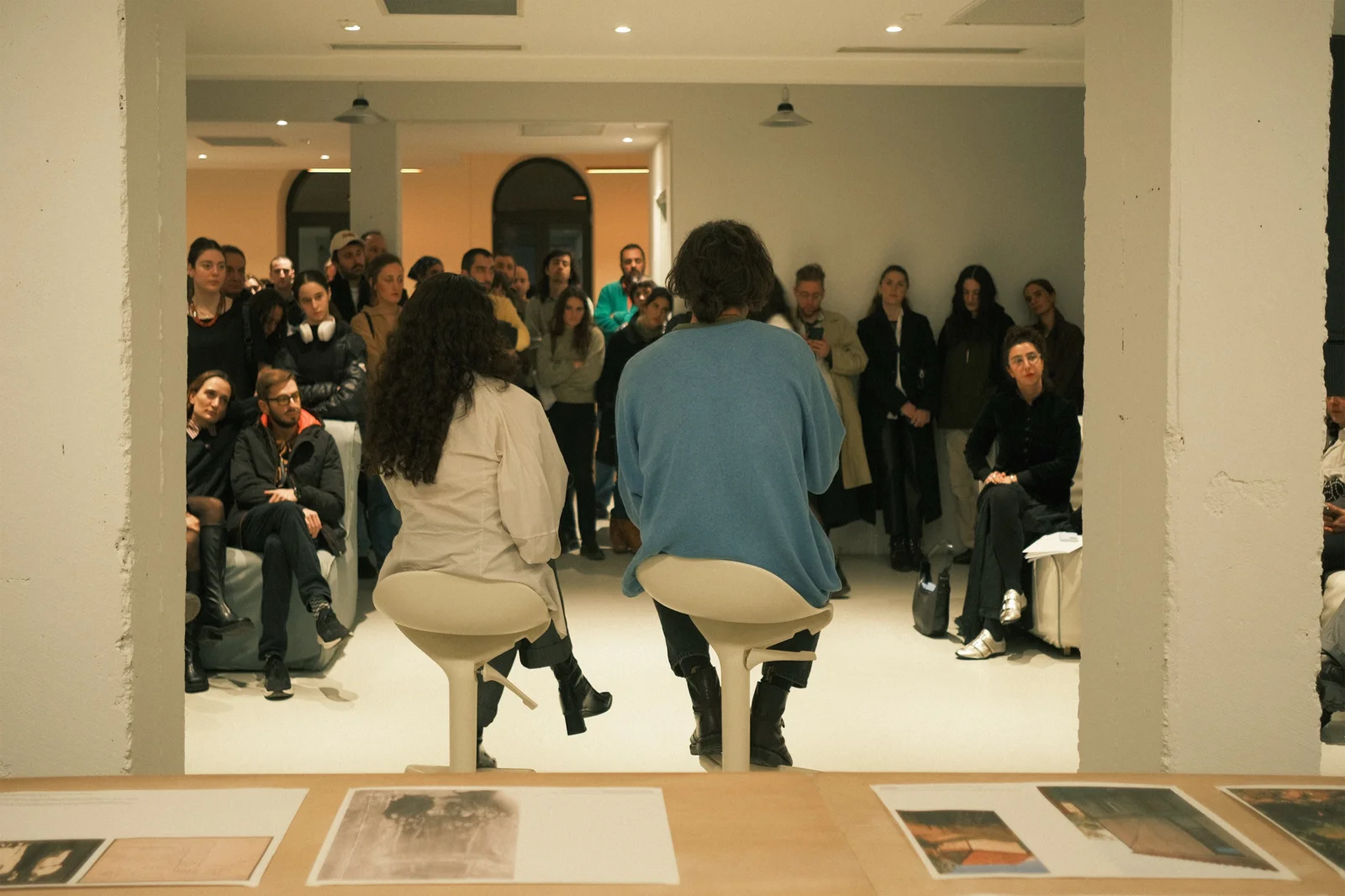
The exhibition brought together a layered archive of Chiatura’s geological, social, and infrastructural damage—including the first public screening of Andro Chiaureli’s 1989 film The Wound.
Dineba — A Digital Archive of Georgia’s Ecological Landscape is an ongoing, multi-stage initiative to build a digital archive of Georgia’s ecological landscape while gradually decentralising who governs it. The project draws together research on how environmental risk forms, how disasters are intensified by climate change, and how the state responds to them—alongside questions of river access, collective rights, and the relationship between communities and the natural resources around them. It also looks at hydropower infrastructure, resistance to extractivist development, and the material and psychological damage that industrial activity leaves behind on both landscapes and the inhabitants.
Our investigation focused on the municipality of Chiatura, one of the most vulnerable and precarious landscapes in the region. Chiatura is a site of rapid extraction of manganese—a mineral crucial for industries like steelmaking, metallurgy, battery production and chemicals. Historically this small region produced a massive amount, at times accounting for up to 60% of global output of the mineral. Paradoxically, as happens in many extractive zones around the world, this wealth became the very reason for the region’s wild exploitation, its colonisation, and most importantly the instrumentalisation of both the labourers working in the mines and of nature itself.
Our research approach aimed to go beyond the declared reality of top-down social and political design and language, which comprehends nature as dead, passive, and separate from humans—a view that is convenient for continuing the careless devastation of the landscape. That reality profoundly ignores the flows, the movements, and the forces of aliveness that exist between different more-than-human actors, between nature and us. So we follow wounds: not only human wounds but ecological, environmental and geological ones. The main argument of the research is that all these wounds are entangled, triggering and creating one another.
Why the wound
It began as the working title. But archives are magical places where things happen exactly as they were meant to, and that is how we rediscovered Andro Chiaureli’s 1989 film The Wound (ჭრილობა), about Chiatura. It was a massive coincidence, and a sign that we were on the right path.
We use the word wound against the instrumentalisation of nature in a neocapitalist world. It is a call for radical care. We know that nature is alive, similar to human beings—when you speak these words they sound like a simple truth, yet the practices we have adopted as a species stand very far from this belief. A wound is not just damage; it is a site where the abstract violence of industrial logic inscribes itself onto the physical world. It is undeniable evidence.
Memory and the archive
Our mission with this archive is not problem-solving in the traditional sense. The issue in Chiatura is so long and so complex—spanning the pre-Soviet era, the Soviet period, and today—that it would be naive to believe we could fix it in our lifetime. Instead our goal is to document. To pay attention. To record the nonhuman actors that will be here when we are gone, and to create tools for upcoming generations to investigate these issues. We think here about the memory of nonhuman actors such as trees, whose memory is valuable because they will stick around much longer than we will—something we tend to forget.
The films
Two films anchor the collection. Chiatura (1951, dir. Gunia) shows, from its first minutes, the theatricality of Soviet rhetoric: it consistently invokes Akaki Tsereteli and his dreams about Chiatura—dreams that supposedly only came alive under Soviet rule—and uses nationalistic music to bridge Georgian national identity with Soviet industrialism. There is something eerie in its triumphalism.
The Wound (ჭრილობა, 1989, dir. Andro Chiaureli) was presented here to an audience for the first time. We collaborated with Andro himself and with Giorgi Kakabadze of the National Archives to digitise it. Where the earlier film performs, The Wound juxtaposes the monotonous, low-pitched, unapproachable voice of Soviet officials with the unheard voices of local communities, psychologically wounded as they navigate their wounded land. It is the same scenario as today: officials refusing to admit that the destruction of homes has anything to do with mining. Like our own research it offers no resolution—it simply demonstrates an open wound, which after almost thirty-seven years is still open, and more drastically so.
The split walnut tree
We first encountered this creature, a walnut tree split in half by the extractive processes at work in Chiatura, during a trip organised by Tbilisi Architecture Biennial, guided by Sopho Aptsiauri. It continues to affect us. Once it was one tree. Now there is a twenty-metre distance between its halves. The scar is still visible on each side. And yet they stand as a living testament to the slow violence of the landscape—a memory keeper that refuses to be erased.
Archive Contributors: Elisabed Gedevanishvili, Ana Mikadze, Tatuli Japoshvili and Giga Tsikarishvili (platform wit[h]nessing), Eka Tsotsoria
Curator: Nina Akhvlediani
Exhibition Design: Julie Dalsgaard Hvass, in collaboration with Nina Akhvlediani
Graphic Design: Archil Tsereteli
Texts: Lika Gulbani, Elisabed Gedevanishvili, Giorgi Tsintsadze, Ana Mikadze
Website Design: Cent Holsten
Photos courtesy of: Grigory Sokolinsky and Dineba