(Un)Learning Architecture
A reflection on instability in architecture, written as the concluding text of the ETSAM MPAA15 course—against linear accounts and simplistic solutions, and for thinking through humble agents.
- Year
- 2024
- Format
- Essay
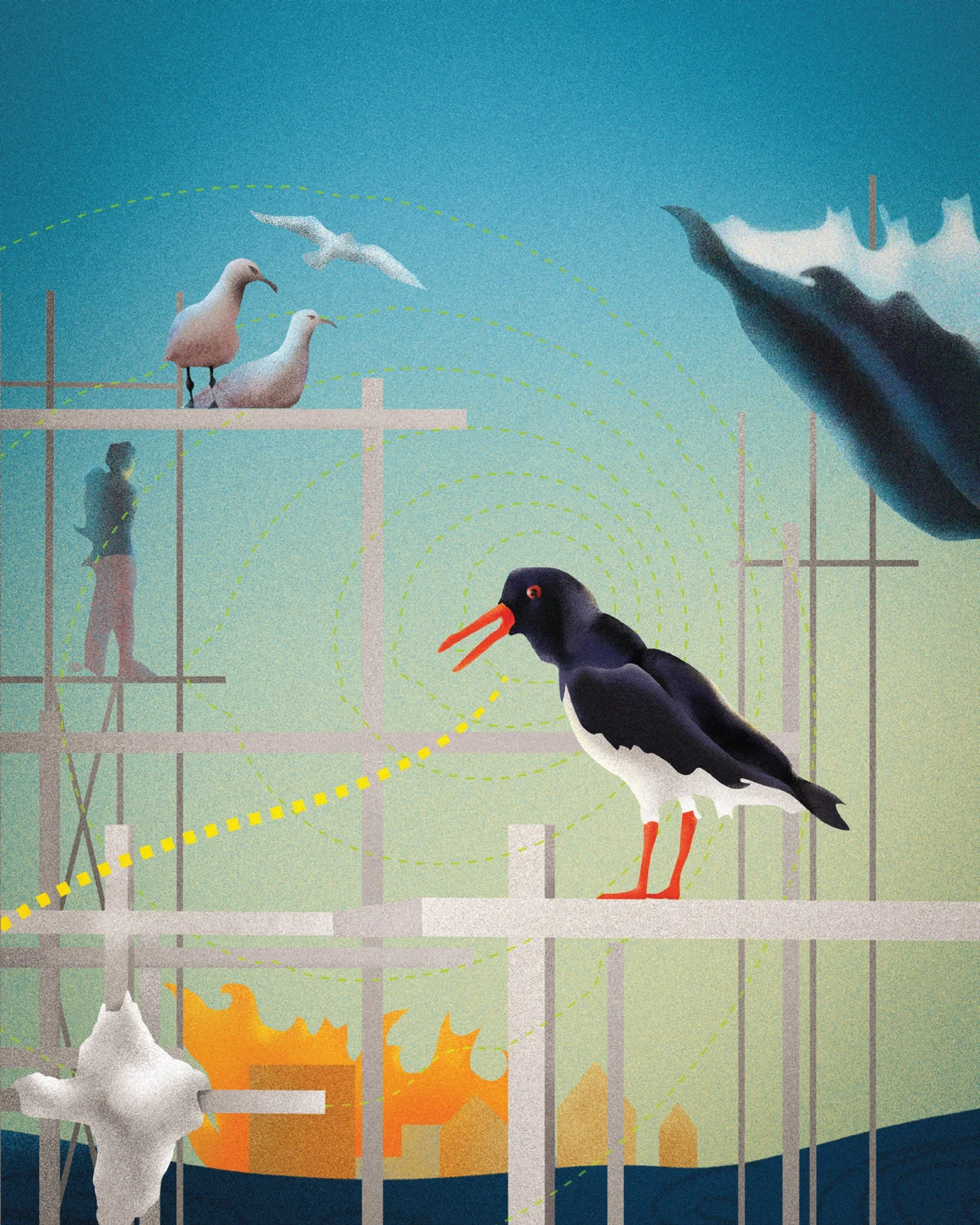
What images and concepts come to mind when thinking about architecture? What narratives can architectural practice convey in today’s turbulent times? How can we reconcile beliefs of the past with the necessities of the future? What principles and values should we remain loyal to? What responsibilities do we hold as spatial practitioners?
“Our task is to make trouble, to stir up potent response to devastating events, as well as to settle troubled waters and rebuild quiet places,” Donna Haraway asserts, emphasising the controversial role of both unsettling and calming in navigating the current complex condition. If this collection of myriad short chapters achieves something, it is precisely about “making trouble.” Seeking to disrupt conventional thinking and provoke critical responses, the anthology does not present linear accounts, narratives, or simplistic solutions. Instead, it manifests as an interrupted, multidirectional, and unpredictable assemblage of ideas and images. By offering diverse perspectives on the notion of instability in architecture and beyond, the collection facilitates negotiations among a multitude of voices rather than advocating for universal solutions.
How else could one address the apparent unpredictability, elusiveness, and dynamism of the effects of current happenings such as the climate crisis, wars, migration movements, resource conflicts, pandemics, and technological changes? What if, in trying to understand and represent such unstable events, chaos, anachrony, and anarchy form the basis of the new (dis)order we are striving for?
Yet there is a controversy that must be taken into consideration. On one hand, fluctuations, emergencies, and disasters can open room for alternative thinking, as well as ways of living, playing, and dying together in the world. On the other hand, one must be aware of how the moments of instability can be manipulated for specific ideological purposes by those in positions of power. By seizing opportunities for political and economic interests these powers might take advantage of moments of shock to push policies driven by a neoliberal and neo-modernist agenda, thus shifting from possibilities to trouble, devastation, and even tragedy. Creating the illusion of technocratic solutions, oftentimes, these policies reduce the complexity of environmental and social systems to manageable, simplified models, ignoring their intricate, interconnected, and often unpredictable nature. For this very reason, it is essential not to confuse maps with territories and consider the controversy of instability within each locality, where potential and risk mutually coexist.
One of the ways to secure the aforementioned risks is to think against predominant hierarchical systems—human-centric and ontologically masculine. The world deeply wounded by these systems calls for a deeper understanding and a shift in our perception. Thinking through humble agents, minor actors, or subaltern voices might offer some pathways to navigate these complexities, allowing us to embrace more inclusive, diverse, and resilient forms of knowledge and practice. Anna Tsing eloquently refers to this condition as a “patchy Anthropocene,” reflecting the fragmented yet interconnected nature of all things. In her exploration of The Mushroom at the End of the World, Tsing argues that recognising current precarity as a global condition enables us to perceive the true state of our world. Traditional analyses fixated on progress and growth often overlook the heterogeneity of space and time. Embracing this patchy unpredictability demands a reviving of imagination.
Tsing compares her riot of short chapters to “flushes of mushrooms that come up after rain: an over-the-top bounty; a temptation to explore; an always too many.” Similarly, the projects in this book act as a network of seemingly distant yet interconnected explorations, inquiries, and discoveries. Unlike hegemonic, top-down, and conventional perspectives, the assemblage addresses the current crisis of the architect as a subject, the representational crisis in architecture, and the perception of the world in the broader collective imagination. Attempts to nurture the ground where ideas, metaphorically akin to mushrooms, can flourish are especially significant in educational settings. These are spaces within lower hierarchical levels where critical interruptions occur, and the traces of devastation might become apparent.
Acknowledging the necessity of criticality and emergency to move beyond the confines of modern stability creates room for a novel form of connection to the world we inhabit. Furthermore, this subversion fosters alternative design methodologies, resulting in increased awareness, heightened sensibility, and diverse narratives. Cultivating such habits of unlearning may be prompted by latent, albeit pervasive, unstable conditions that often remain concealed or disregarded. In the context of modernity and the existential crises it brings, we have lost the sense of the world. And architecture is a perfect medium through which to contribute to rethinking multiple crises and envision futures of coexistence.